


Dr. Shaik Rusthum
Principal & Professor
Academic Leader | Researcher | Mentor | Institution Builder
M.Tech., Ph.D., MISTE, MISRS, F.I.E.
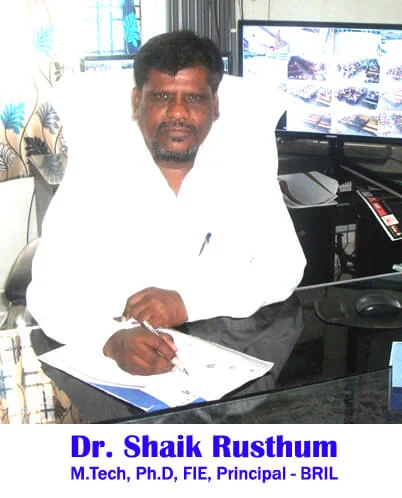
Dr. Shaik Rusthum is an accomplished academician, researcher and institutional leader with 33 years of experience in higher education, spanning teaching, research, academic administration, doctoral supervision, professional development and institutional leadership. He has been serving as Professor & Principal of Brilliant Institute of Engineering and Technology since January 2010, bringing to the institution more than three decades of experience in engineering education and academic administration. His academic journey is rooted in Civil Engineering, with specialization in Free Surface Flow, Hydraulics and Hydraulic Machinery, GIS and Remote Sensing. He holds a B.E. in Civil Engineering from Osmania University, Hyderabad, an M.Tech. from Andhra University, Visakhapatnam, and a Ph.D. in Civil Engineering from Osmania University, Hyderabad.
Throughout his career, Dr. Rusthum has remained closely connected with the fundamental purpose of higher education: to transform knowledge into capability and capability into meaningful professional contribution. His experience has taken him from classroom teaching and research to institutional leadership, allowing him to understand engineering education from the perspectives of the student, faculty member, researcher, academic administrator and institutional leader.
For him, the success of an engineering institution cannot be measured simply by the number of students enrolled, subjects completed or examinations conducted. The more important question is whether the institution has enabled its graduates to think, understand, apply, analyse, design, innovate, communicate, collaborate and solve real-world problems responsibly.
This philosophy provides the foundation for his approach to academic leadership at Brilliant Institute of Engineering and Technology.
Engineering is an application-oriented discipline. Its purpose is not limited to understanding theories, formulas and technologies; it is fundamentally about using knowledge to solve problems and create solutions that improve human life and society.
Dr. Rusthum believes that engineering education must therefore prepare students to move confidently from the classroom to the professional world. A graduate should not merely remember what has been taught, but should be able to demonstrate what he or she can do with that knowledge.
This requires engineering education to develop much more than disciplinary knowledge. It must cultivate technical competence, analytical thinking, problem-solving ability, creativity, design capability, communication skills, teamwork, professional ethics, leadership, social responsibility and the capacity for lifelong learning.
The objective is to develop graduates who can respond to unfamiliar challenges, adapt to rapidly changing technologies and continue learning throughout their professional lives.
This understanding naturally leads to an educational philosophy centred on learning outcomes.
One of the central principles guiding modern engineering education is Outcome-Based Education (OBE).
For Dr. Rusthum, OBE should not be treated simply as an accreditation terminology or a documentation requirement. It represents a fundamental shift in the way an institution thinks about education.
The question changes from:
"What have we taught?"
to:
"What has the student learned, and what is the student capable of demonstrating?"
This distinction is fundamental.
In an outcome-based system, the educational process begins by identifying what a graduate should ultimately be able to achieve. The curriculum, teaching-learning methods, laboratory experiences, projects, internships, assessments and student-development activities are then aligned towards those intended outcomes.
The National Board of Accreditation describes outcome-based education as an approach aimed at achieving desirable outcomes in terms of knowledge, skills, attitudes and behaviour, supported by regular assessment of outcome attainment and benchmarking against programme outcomes. NBA also emphasizes that educational quality should be judged through outcomes rather than merely through inputs.
This philosophy strongly complements Dr. Rusthum's view that the ultimate measure of engineering education is not simply the successful completion of a programme, but the competence demonstrated by its graduates.
A meaningful OBE framework creates a logical connection between the institution's aspirations and the capabilities of its graduates.
The academic journey can be understood as:
This alignment ensures that every academic component has a clear purpose.
Course Outcomes should not exist merely as statements in course files. They should influence lesson planning, classroom delivery, laboratory activities, assignments, projects and assessment. At the programme level, course-level learning should collectively contribute towards broader graduate attributes and programme outcomes.
The current NBA UG Engineering Tier-I manual reinforces this alignment by emphasizing defined COs, their linkage with POs and PSOs, course articulation, outcome-based teaching-learning, continuous assessment, feedback and continuous improvement. It also highlights the importance of projects, internships, industrial training, experiential learning and real-world engineering problems.
For Dr. Rusthum, this alignment represents academic integrity: what an institution promises, what it teaches and what its graduates ultimately demonstrate should be meaningfully connected.
An engineering programme becomes meaningful when students are able to connect theory with practice.
Classroom knowledge provides the foundation. Laboratories provide experimentation. Projects provide integration. Internships provide professional exposure. Industry interaction provides context. Research provides inquiry. Innovation provides creativity. Assessment provides evidence of learning.
Together, these experiences can transform students from passive recipients of information into active learners and problem solvers.
Dr. Rusthum's academic philosophy therefore places importance on creating opportunities for students to apply engineering concepts to practical situations.
The objective is to progressively develop the student's ability to:
Understand → Apply → Analyse → Design → Experiment → Evaluate → Create → Improve
Such progression is particularly important in engineering because professional problems rarely appear in the same form as textbook questions.
An engineer must be capable of interpreting incomplete information, identifying the actual problem, evaluating alternatives, selecting appropriate tools, designing a solution and understanding the consequences of that solution.
At the heart of outcome-based education is the learner.
Dr. Rusthum believes that an engineering institution must create an environment where students actively participate in the learning process rather than merely receive information from the classroom.
Student-centric education can take many forms: experiential learning, laboratory experimentation, problem-based learning, project-based learning, case studies, technical competitions, seminars, simulations, internships, industry exposure, research projects and self-learning.
The objective is not to increase the number of academic activities simply for the sake of activity. Each learning experience should have a clear educational purpose and measurable contribution towards student development.
The latest NBA UG Engineering Tier-I manual specifically emphasizes interactive teaching-learning methods, ICT-enabled tools, continuous assessment, student feedback, seminars, projects, case studies, real-life examples, NPTEL/MOOCs, internships, industrial training and capstone projects as components that can strengthen learning outcomes.
This reinforces an important principle of Dr. Rusthum's educational vision: students learn best when they are given opportunities to engage, experiment, solve and reflect.
In an outcome-based educational system, assessment should do more than produce marks.
Assessment should provide evidence of whether students have achieved the intended learning outcomes.
Different forms of learning require different forms of assessment. Conceptual understanding may be evaluated through examinations, while application and design capabilities may be better demonstrated through laboratory work, projects, design exercises and practical assignments. Communication and teamwork can be observed through presentations, collaborative work and project activities.
The question therefore moves beyond:
"What marks did the student obtain?"
towards:
"What does the student's performance demonstrate about the learning outcome?"
This approach makes assessment an integral component of the teaching-learning process.
Assessment data can then be used to identify learning gaps, strengthen instructional strategies and provide targeted academic support.
OBE does not end with assessment.
The institution must examine the evidence, determine the level of outcome attainment, identify areas requiring improvement and implement appropriate corrective or enhancement measures.
This creates a continuous cycle:
This principle of continuous quality improvement is central to outcome-based accreditation. NBA describes accreditation as a quality-assurance and improvement process and states that accreditation helps institutions identify strengths, weaknesses and opportunities and continuously improve programmes.
For Dr. Rusthum, therefore, quality should never be regarded as a destination. Quality is a continuous institutional habit.
Dr. Rusthum views NAAC and NBA not merely as accreditation mechanisms, but as frameworks that encourage institutions to establish systematic cultures of quality, accountability and improvement.
NAAC provides an institutional perspective on quality, while NBA focuses on the accreditation of specific technical education programmes. NBA itself makes an important distinction: NBA accredits programmes, not entire institutions or departments.
For an engineering institution, these complementary perspectives encourage attention to the complete educational ecosystem—curriculum, teaching-learning, assessment, faculty, infrastructure, research, student support, governance, stakeholder engagement and outcomes.
NBA's objectives include promoting excellence through benchmarking, relevance to market needs, participation of stakeholders and continuous quality improvement.
Dr. Rusthum's academic leadership philosophy therefore sees accreditation as an opportunity to ask meaningful institutional questions:
These questions are more valuable than treating accreditation as a periodic exercise.
Engineering education cannot exist in isolation from industry and society.
Technology changes rapidly, professional roles evolve and new areas of engineering emerge continuously. An effective institution must therefore maintain meaningful connections with industry, alumni, employers, professional bodies, faculty and students.
Stakeholder feedback can help institutions understand whether curriculum content, laboratory facilities, technical skills, professional skills and graduate competencies remain relevant.
NBA identifies excellence, relevance to market needs and stakeholder participation as major determinants of quality-conscious technical education.
For Dr. Rusthum, this means that curriculum development and programme improvement should remain dynamic rather than static.
Students must receive strong fundamental knowledge while also developing the ability to adapt, learn new technologies and apply their knowledge in changing professional environments.
Dr. Rusthum's vision extends beyond producing technically qualified graduates.
Engineering education should develop the complete professional.
A graduate should possess technical knowledge, but also demonstrate:
This is the broader purpose behind outcome-based engineering education.
Dr. Rusthum's own academic journey demonstrates the importance he places on research.
His research experience spans Civil Engineering and interdisciplinary applications of GIS, Remote Sensing, spatial databases, watershed management, transportation engineering, urban development, infrastructure planning and construction materials.
His CV records 20 papers published in international and national conferences and journals.
His recent publications include research in 2021 on industrial red mud waste for self-compacting concrete, cement replacement using bentonite and glass powder, scrap steel applications and road construction strategies. His 2020 research includes driver behaviour and traffic psychology, lightweight aggregate/floating concrete and carbonate geopolymer concrete. Earlier research includes sustainable construction materials, geopolymer concrete, recycled plastic, GIS, Remote Sensing and solar PV site selection.
His earlier research from 2013 through 2006 includes spatial databases, Remote Sensing, image processing, urban development, transportation networks, GIS/GPS and land-use analysis.
His work demonstrates an academic career that has evolved with technology—from traditional Civil Engineering problems towards increasingly interdisciplinary applications of geospatial technologies, data analysis and sustainable engineering.
Research leadership is further reflected in Dr. Rusthum's contribution to doctoral education.
He has successfully guided three Ph.D. scholars, whose research covered advanced applications of Remote Sensing, GIS, spatial databases and urban and infrastructure development.
The completed research included Object-Oriented Image Analysis for Urban Development and Management, Future Projections for Growth Demands and Impacts on Infrastructure Using RS and GIS, and Multi-Resolution Based Knowledge Extraction from Spatial Database and its Application to Region-Based Interpretation of Remotely Sensed Imagery.
The CV additionally records three scholars under his guidance in research areas involving renewable energy and Remote Sensing, GIS-GPS transportation networks and travel-time and delay analysis.
Through research guidance, Dr. Rusthum has contributed to developing researchers capable of addressing complex engineering and technological problems through systematic investigation.
Dr. Rusthum's leadership experience has developed progressively throughout his academic career.
Since January 2010, he has served as Professor & Principal of Brilliant Institute of Engineering and Technology. His Principal appointment has been ratified by Jawaharlal Nehru Technological University Hyderabad four times—in 2010, 2015, 2018 and 2021.
Prior to BRIL, he served as Professor & Principal of VIF College of Engineering & Technology from July 2007 to June 2009.
In 2008, he was appointed as a Technical Committee Member and Research and Development Committee Member at Maulana Azad National Urdu University, Hyderabad.
In 2005, he served as Adviser to the Institution of Engineers (India) Student Chapter at Muffakham Jah College of Engineering & Technology and was involved in establishing a new student chapter.
This progression reflects a career in which academic responsibilities steadily expanded into institutional and professional leadership.
Dr. Rusthum has also gained extensive experience in examination administration. He has served as Chief Superintendent for more than 36 examinations, including examinations conducted by the Andhra Pradesh Public Service Commission, Telangana State Public Service Commission, NEET and POLYCET.
Such responsibilities require careful coordination, procedural discipline, confidentiality, academic integrity and institutional accountability.
This experience complements his broader understanding of academic governance and reinforces his emphasis on transparent, systematic and responsible academic processes.
Dr. Rusthum has continued his professional development even after assuming senior institutional leadership responsibilities.
In 2021, he completed a 12-week NPTEL course in Fluid Mechanics and participated in a programme on Digital Teaching Techniques organized by ICT Academy from 21–25 September 2021.
In 2019, he participated in a Principal's Meet on "Challenges of Academic Administration in 21st Century", an All India Seminar on Cyber Security and Image Processing, an Art of Living Programme for Directors and Principals of JNTUH-affiliated colleges, and a workshop on Speed and Safety Measures in Construction Projects.
In 2018, he participated in an AICTE workshop on Examination Reforms, while in 2017 he participated in a National Corporate-Campus conference. In 2015, he participated in a workshop on Outcome-Based Education and Accreditation organized by the National Board of Accreditation and JNTUH.
These activities demonstrate continued engagement with emerging educational practices, institutional administration and technological developments.
Dr. Rusthum has consistently encouraged professional and technical engagement among students and academic communities.
In 2013, he served as Chief Patron for the National Level Android Developer Challenge organized by Brilliant Institute of Engineering and Technology. In 2012, he served as Patron for Brilliance Exploration, a national-level conference on latest trends and technology. In 2010, he served as Convener of the National Level Student Technical Fest "BRILLIANT ASTHRA 2010."
Earlier, in 2002, he served as Convener of the National Conference on "Geographic Information System & their Application in Civil Engineering (GIS ACE-2K2)" at Deccan College of Engineering & Technology.
These experiences reflect his longstanding belief in giving students exposure to technical communities, emerging technologies and professional interaction beyond conventional classroom learning.
Dr. Shaik Rusthum is a Fellow Member of the Institution of Engineers (India), a Life Member of the Indian Society for Technical Education (ISTE) and a Life Member of the Indian Society for Remote Sensing (ISRS).
These professional affiliations connect his academic work with wider engineering, technical education and Remote Sensing communities.
Dr. Rusthum's current and longest leadership association is with Brilliant Institute of Engineering and Technology, where he has served as Professor & Principal since January 2010.
Before joining BRIL, he served as Professor & Principal at VIF College of Engineering & Technology from July 2007 to June 2009.
From February 2005 to July 2007, he served as Associate Professor at Muffakham Jah College of Engineering & Technology.
His academic career began in August 1989 at Deccan College of Engineering & Technology, where he served as Assistant Professor until February 2005.
This progression from Assistant Professor → Associate Professor → Professor & Principal → long-standing institutional leadership represents more than professional advancement. It reflects the gradual development of expertise across teaching, research, administration and institutional governance.
Dr. Rusthum's academic foundation was established through his Civil Engineering education at Osmania University, where he completed his B.E. in Civil Engineering during 1984–1988. He pursued postgraduate study at Andhra University and completed his M.Tech. during 1992–1994. He subsequently completed his Ph.D. in Civil Engineering from Osmania University during 1998–2003.
His specialization in Free Surface Flow, Hydraulics, Hydraulic Machinery, GIS and Remote Sensing has influenced both his teaching and research career.
An important characteristic of Dr. Rusthum's career is his continued engagement with learning.
From his early professional development programmes in Watershed Management and Ground Improvement Techniques, to the UGC-sponsored Orientation Course in 2001, the ISRO-sponsored Refresher Course in Spatial Information Technology in 2004, and his later engagement with NPTEL, digital teaching, OBE, accreditation and academic administration, his professional development has evolved alongside changes in engineering education and technology.
This lifelong-learning orientation is particularly relevant to engineering education, where technological change requires both students and educators to remain continuously adaptable.
Institution building, in Dr. Rusthum's philosophy, is a continuous process.
It requires strong academic leadership, committed faculty, effective teaching-learning systems, meaningful assessment, relevant curriculum, research, infrastructure, student support, stakeholder engagement and responsible governance.
Accreditation frameworks such as NAAC and NBA provide important structures for systematically evaluating and improving these dimensions.
NBA states that accreditation is a process of quality assurance and improvement, intended to verify that programmes continue to meet prescribed standards while encouraging institutions to identify strengths, weaknesses and opportunities for continuous improvement.
For an institution such as BRIL, therefore, quality should not be viewed as something demonstrated only during an accreditation cycle. It should be visible in the everyday academic experience of students.
And ultimately, quality should be visible in what BRIL graduates are able to contribute to industry and society.
The engineering profession is changing rapidly. Artificial intelligence, automation, digital technologies, advanced manufacturing, sustainable engineering, data-driven decision making and interdisciplinary problem solving are transforming the nature of engineering work.
In such an environment, students cannot be prepared only for today's technologies.
They must be prepared to learn tomorrow's technologies.
This is why strong fundamentals, analytical thinking, problem-solving capability, communication, professional ethics and lifelong learning are as important as technical specialization.
An outcome-based approach provides a framework for developing these capabilities because it keeps the focus on the graduate and the competencies the graduate must demonstrate.
For Dr. Rusthum, the most important outcome of an engineering institution is not an examination result, a certificate or even the completion of a curriculum.
It is the graduate.
The real measure of institutional success is the extent to which a student who enters the institution with potential leaves with the competence, confidence, character and capability to contribute meaningfully.
A successful BRIL graduate should be able to enter industry with confidence, pursue higher education with strong foundations, undertake research with curiosity, explore entrepreneurship with courage and participate in society with responsibility.
This is the larger purpose of engineering education.
Dr. Shaik Rusthum's academic career brings together three important dimensions:
Education — A sustained commitment to teaching, learning and student development.
Research — A long record of research, publications and doctoral supervision across Civil Engineering and interdisciplinary technological applications.
Leadership — More than three decades of academic experience and long-standing institutional leadership as Professor & Principal.
These dimensions converge in an educational philosophy where teaching should produce learning, learning should produce competence, competence should produce professional capability, and professional capability should ultimately contribute to society.
As Brilliant Institute of Engineering and Technology continues its journey of academic development, the role of institutional leadership is to ensure that growth remains connected to educational purpose.
The future demands institutions that are not merely large, but academically strong; not merely technologically equipped, but educationally effective; not merely examination-oriented, but outcome-oriented; and not merely focused on employment, but committed to developing professionals capable of continuous growth.
Dr. Rusthum's vision is therefore aligned with an academic culture in which quality is systematic, learning is measurable, teaching is student-centric, research is encouraged, industry relevance is maintained and continuous improvement becomes an institutional habit.
Dr. Shaik Rusthum's professional journey, spanning more than three decades, represents a sustained commitment to engineering education and academic leadership. From his early years as an Assistant Professor to his progression through academic and leadership positions and his long-standing service as Professor & Principal of Brilliant Institute of Engineering and Technology, his career has remained closely connected with the development of students, faculty and academic institutions.
His research contributions in Civil Engineering, GIS, Remote Sensing, spatial analysis, transportation, urban development and sustainable construction, together with his doctoral supervision and professional engagement, reflect an academic career that has evolved with changing technological and societal needs.
Today, his leadership at BRIL is grounded in the conviction that engineering education must have a measurable purpose. The institution must know what it intends its graduates to become, design learning experiences accordingly, assess whether those outcomes are being achieved, and continuously improve the educational process based on evidence.
In this context, Outcome-Based Education is not simply an accreditation requirement. It is a philosophy of accountability to the learner.
It asks the institution to make a promise to every student:
You will not simply be taught. You will be enabled to learn.
You will not simply complete courses. You will develop competencies.
You will not simply earn a degree. You will develop the ability to contribute.
And ultimately:
— Dr. Shaik Rusthum
Dr. Shaik Rusthum
Principal & Professor
Brilliant Institute of Engineering and Technology
ADMISSIONS OPEN 2026-27 · Fill the form and we'll call you within 24 hours